Book Store
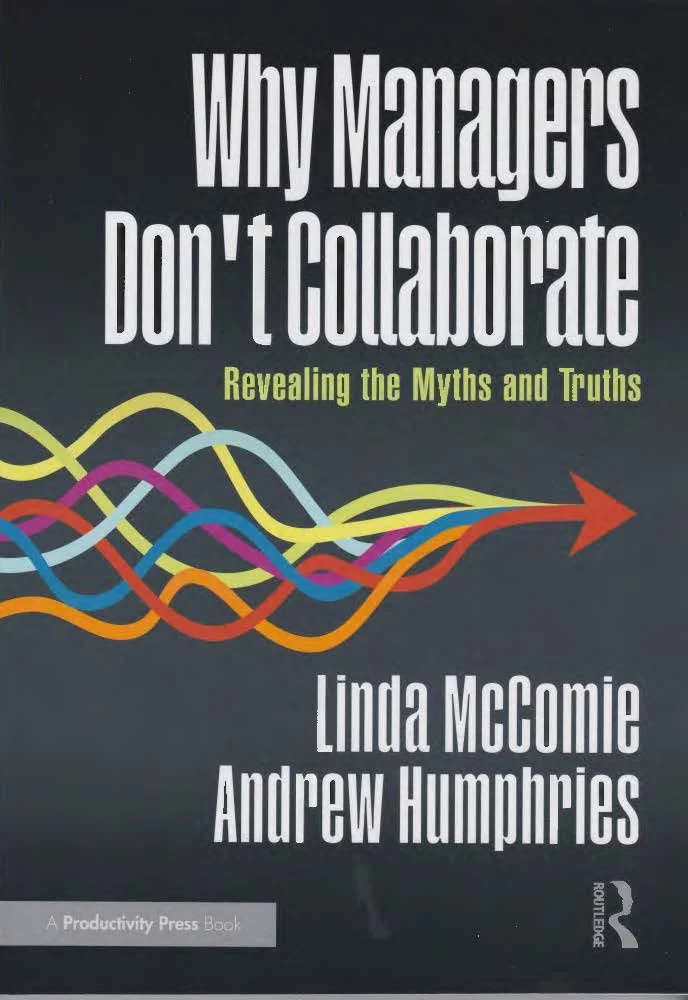
Why Managers Don't Collaborate Revealing the Myths and Truths
by Linda McComie & Andrew Humphries, Productivity Press 2026, ISBN 9781041130178, 310 Pages
This book is an innovative and controversial approach to dispel the baseless myths that are preventing managers of organizations from moving forward and reaping the benefits of collaboration. Compared to most publications on the market, this book is packed with the rich results of 20 years of research. It is based on over 200 studies in a wide variety of public, private, and international settings and over 4000 quotations gathered from interviews with managers. Many have been selected to illustrate the case studies and key points in the book. Collaboration has been presented as a serious business strategy for at least 50 years. Scads of books, papers, and conferences by consultants, academics, institutes, associations, and governments have trumpeted its benefits, and many online discussion channels are extolling the same messages. This book faces off against all this gung-ho hype that has patently failed in most alliance cases to achieve the full extent of the potential return,s such as improved revenues, reduced costs, greater market share, access to specialized know-how, and increased resilience in difficult economic conditions.
The authors have looked at over 200 organizations in many industries and public sectors across the world, and in most cases, they have claimed they are collaborating, but it is not happening. This is the first Big Myth. The second Big Myth is that managers ignore it because they don’t have the foresight to realize how collaboration will benefit their operations, and so they find excuses why they don’t need to do anything. Many believe that closer working with partners is more trouble than it’s worth; it’s a black art ‘where we don’t know what to do, we don’t know that we don’t know what to do, it’s someone else’s job, or we don’t have the time, money or inclination to do it’. These attitudes are prevalent despite the high value (both bottom-line and strategic) that is usually tied up in the often long-standing formal and informal agreements between organizations. They also ignore the adverse impact on staff workloads, motivation, development, and morale, and seriously undermine their enormous potential contribution to alliance success.
The purpose of this book is to dispel these myths because the research has clearly shown that they are baseless and are stopping managers and organizations from moving forward and gaining the benefits of collaboration that are there for the taking. This is groundbreaking and contentious because, for the first time, the universal misuse and obfuscation of the collaboration concept is being confronted. After many years, collaboration has become a cozy buzzword that is thrown around randomly and not taken seriously.
“In capital-intensive, high-risk industries, collaboration is not a slogan; it is a capability. This book strips away the comforting myths that too often undermine alliances and replaces them with clear, practical principles rooted in experience, evidence, and common sense. What distinguishes this work is its honesty. It acknowledges why collaboration fails in the real world, short-termism, weak leadership, misplaced governance, and cultural blindness, and shows how organizations that confront these realities can unlock extraordinary value. I have seen firsthand how projects succeed or fail based not on contracts or technology, but on how leaders design relationships, empower people, and manage complexity across organizational boundaries.
For executives, project leaders, and boards, this book is a call to action. Apply its lessons, and you move beyond transactional thinking toward resilient partnerships that deliver better outcomes for shareholders, clients, and the people doing the work. Ignore them, and the myths will continue to quietly erode performance. This is not a book about being idealistic. It is a book about being effective.”
Ed Humphries, VP Minerals and Metals Global Capabilities, Atkins Realis, Montreal, Canada
“With deep evidence and unmatched practitioner insight, the authors reveal why collaboration fails—and provide leaders with practical tools to make it succeed where it matters.”
Dr. Richard Gibbs, Senior Lecturer in Business and Management, Faculty of Business, Law and Digital Technologies, Southampton Solent University, Southampton, UK
“ In an era marked by global volatility and escalating supply chain challenges, collaboration is a requirement to enable resilience — but only when it is actively designed, governed, and led. Too often, organizational relationships are left to chance and rhetoric replaces disciplined practice. Drawing on decades of evidence-based research into collaborative networks, risk and strategic performance, this book cuts through the myths that prevent collaboration from delivering value. The authors offer thoughtful, challenging insights that enable managers to take action and manage collaborative relationships more effectively, turning them into a genuine source of resilience and adaptability, thus sustaining performance.”
Professor Richard Wilding, OBE. Emeritus Professor of Supply Chain Strategy, Author and Presenter of LinkedIn Learning: Supply Chain Foundations: Risk and Resilience
“ Linda McComie and Andrew Humphries, leading experts in collaborative performance, present the definitive roadmap for managers worldwide, an essential guide to unlocking collaborative value. This groundbreaking book confronts the myths and excuses that prevent effective collaboration. Drawing on over two decades of research and thousands of manager interviews, it reveals why collaboration so often fails and provides a clear, evidence-based framework and practical principles to finally make it succeed. Move beyond empty rhetoric. This provocative, pragmatic guide shows senior executives and decision-makers how to transform their alliances into a disciplined practice that delivers lasting, measurable results.”
Dr. Carlos Mena, Associate Dean of Graduate Programs, Daimler Endowed Professor of Supply Chain Management, Portland State University, USA
“This book should be essential reading for every senior manager. As a CEO running two UK-based SMEs, I find that in-depth collaboration is essential for my companies to compete with much larger competitors, some of whom are MNCs. We have at least 16 medium and long-term Partnerships that extend well beyond routine vendor, trading, or distribution arrangements. The relationships must be grounded in mutual trust and disclosure. Therefore, avoiding the common pitfalls that prevent selecting the "right" partner is essential because long experience and a few failures en route make this a perfectly attainable goal. Benefits to my companies include increased market share, a broader technology portfolio, and reduced costs through shared planning and product design.”
Mike Reilly, MBE, CEO of Ether NDE Ltd, Baugh & Weedon Ltd, Alban NDE LLC
“With deep evidence and unmatched practitioner insight, the authors reveal why collaboration fails—and provide leaders with practical tools to make it succeed where it matters.”
Dr. Richard Gibbs, Senior Lecturer in Business and Management, Faculty of Business, Law and Digital Technologies, Southampton Solent University, Southampton, UK
“Are you one of those people who view collaboration as a weakness and compromise? If so, you’re definitely missing out on opportunities. Read this book to discover hidden strength.”
Prof. Tim Cummins, President and Head of Research & Learning, World Commerce & Contracting Association
Implementing & Managing Collaborative Relationships
A Practical Guide for Managers
by Andrew Humphries & Linda McComie, Routledge 2022, ISBN 9781032117508, 172 pages
In today’s competitive, globalized marketplace, the provision of services and products is a result of teamwork between several organizations. Relationships between organizations of any size are strategically important. If your supplier falls down at a crucial moment, it can have survival implications for your company or for other members of your supply chain. The management of these strategic assets cannot be left to chance and the same attention that you devote to finance, operations, HR, etc. must be applied to business relationships. Despite this, very few organizations focus on this or are even aware that they need to do it. Those that do are unsure how to do it. This is not helped by business schools that focus on either customer relationship management (CRM) or supplier relationship management (SRM) rather than collaboration between partners (Enterprise Relationship Management).
This book is a unique “go-to” guide for all managers who should be looking at collaboration with other organizations as a new way to attain outstanding results that would not be achieved on their own. Currently, there is nothing else of this nature on the market.
The book identifies relationship management as a pivotal management function. It presents a comprehensive, flexible, end-to-end management process that can be easily incorporated into the existing management structures. Further, they describe the crucial role of the relationship manager who is at the heart of the system and provides the drive to achieve high performance. Any company can tailor this discipline to the needs of its organization – whether an SME or a multi-national company selecting a new partner or managing existing relationships.
This book covers the decision of whether or not to partner and with whom, the creation of an appropriate system of governance, the transition to operations, managing performance for continuous improvement, and, finally, controlled wind-up of the partnership.
Throughout, diagrams to signpost the sequence of activities, checklists of important actions, and job-related worksheets are provided. In addition, there are numerous case studies in a variety of industries and public sectors that will be used as illustrations. Altogether these make this book ideally suitable for experienced managers as well as for training and induction purposes.
Essentially, Implementing and Managing Collaborative Relationships: A Practical Guide for Managers shows managers how they can create and operate a simple and effective system of Enterprise Relationship Management that will enable them to maximize efficiency, resilience, innovation, and profitability.

“It is well recognised that a collaborative relationship will outperform an arm’s length adversarial one. Unfortunately, there are also many examples of failed collaborative relationships that failed to deliver on their promise. The authors of this book quite rightly identify that collaborating with organisational partners takes more than good intentions. It takes a well-planned and communicated approach that is ideally jointly developed between the parties. In this book, you will find a step-by-step guide with worksheets and tools that you and your intended partner can use to develop a joint plan, an execution strategy, and an ongoing relationship management process to keep you on track. It also recognises that the best time to work on your exit plan from the relationship is at its beginning when the relationship is at its strongest. I would recommend this book to anyone who is either engaged in developing or already involved in collaborative relationships as a tool to deliver on the promise that your relationship can deliver.”
Andrew Downard, Ph.D., CEO, Ci-Advisory, Australia
“Implementing & Managing Collaborative Relationships is an invaluable resource for anybody interested in managing business relationships. Humphries and McComie present an authoritative account of how collaborative relationships work and why they don’t work. The practical tools, such as worksheets and checklists, provide a hands-on structure to ensure successful relationship management.”
Dr. Carlos Mena, Nike Professor of Supply Chain Management, Portland State University, USA
“The concept that collaboration delivers better results is not new, but focus on short-term wins frequently stands in the way. The global pandemic has provided a wake-up call, an appreciation that ‘we are in this together’. With more than 60% of commercial executives now pushing for collaborative relationships, this practical ‘how-to’ guide could not be more timely.”
Professor Tim Cummins, University of Leeds School of Law, President, World Commerce and Contracting
“The successive shocks of the pandemic, microchip supply and now emerging inflationary pressures have challenged supply chains more than at any time in the last 20 years. Resilience has now become a key distinguishing factor between organizations, and those that have built the strongest collaborative relationships and networks are best placed to maximize profitability in 2022 and beyond.”
Mike Reilly MBE, CEO, ETher NDE Ltd., Baugh & Weedon Ltd., Alban NDE LLC
Enterprise Relationship Management A Paradigm for Alliance Success
by Andrew Humphries & Richard Gibbs Gower 2015, ISBN: 978-1-4724-2908-7, 234 pages
Richard Gibbs and Andrew Humphries provide a practical guide to the management process and skill sets needed for co-ordinating the business activities that are essential to creating a competitive advantage. Their eight partnership types developed from earlier research help readers adapt their relationship strategies to the different opportunities that present themselves and focus their greatest time and resources on the collaborations that offer the greatest value. The text includes an explanation of the context for collaboration, the principles and drivers for success, as well as techniques for appraisal and management.
This is an excellent overview of the tools, techniques and philosophies behind an enterprise’s successful management of its strategically important relationships. Enterprise Relationship Management will help ensure your organisation has the requisite ability to form, manage, retire and exit partnerships in a fluid and agile way. Whether you are in sales or marketing or finance and operations, this book will show you how to get the most from your partnerships.

“This is an insightful book that unpacks the dynamics of effective ‘enterprise relationship management’ and provides the reader with the tools, techniques, and procedures needed to optimise twenty-first-century supply chains.”
Air Vice Marshal Graham Howard, Assistant Chief of UK Defence Staff (Logistics Operations)
Strategic Alliances & Marketing Partnerships Gaining Competitive Advantage Through Collaboration & Partnering
by Richard Gibbs & Andrew Humphries, Kogan Page 2009, ISBN: 978-0-7494-5484-5, 235 pages
Business partnerships can be characterized in 8 types the G+H Partnering Types. Know your type and you know how to improve its performance. Myers Briggs did it for personality profiling, G+H now do it for alliances. This book takes you step by step through the maze of performance characteristics that make up your partnership profile. You can now take timely and effective action to achieve your objectives.
“This book provides vital and practical understanding”
Anne Mulcahy, President & CEO Xerox Corporation
“Original and thought-provoking”
Martin Christopher, Emeritus Professor, Cranfield School of Management
“These boys are on to something here”
Air Vice-Marshal Matt Wiles CBE, Director General Joint Supply Chain, UK Ministry of Defence
Collaborative Change Creating High Performance Partnerships & Alliances
by Andrew Humphries & Richard Gibbs Andrew Humphries & Richard Gibb 2010, ISBN: 978-1-4538-1608-0, 245 pages
In their second book, Humphries and Gibbs look at how the need for constant organisational improvements and the increase in partnering come together in what they describe as Collaborative Change.
This book looks at the underlying concepts and models that can be applied and critically draws heavily on personal experience to shed light on how such change can be executed through high performing partnerships. This ‘experience’ is related in many case topical studies which include war-fighting in Iraq, team management on a husky sled and operating global, virtual teams in the British Civil Service.
There is a wealth of academic rigor and thought in this book backed by many hands-on examples of how to manage change and partnering effectively. Contributing others include Tim Barnsley, Tim Cummins, Andrew Downard, Graham Haines, Peter Hunter, David Hawkins, Anthony Kesten and Chris Markey.

“Partnering and alliances is a subject that for many years has been in the too difficult category. This book tackles the ‘elephant in the room’.”
Philip Oliver, Group Marketing Director, Fujitsu
Performance Measurement in the Management of Food Supply Chain Relationships
Andrew Humphries & Linda McComie
Chapter 2 in: Delivering Performance in Food Supply Chains edited by Carlos Mena & Graham Stevens – Woodhead Publishing Ltd 2010, ISBN: 978-1-84569-471-5

Building Relationships that Create Value
Richard Wilding & Andrew Humphries
Chapter 3 in: Dynamic Supply Chain Alignment: A new business model for peak performance in enterprise supply chains across all geographies by John Gattorna – Gower Publishing Ltd 2009, ISBN: 978-0-566-08822-3